Featured publication

Vibrotactile Information Coding Strategies

Using a body-worn vibrotactile vest to support robot-human collaboration in high cognitive-load scenarios

Project overview

Adrian Vecina Tercero, Praminda Caleb-Solly · ICSR + AI 2024 / Springer LNAI 15563

This student project explored how a body-worn vibrotactile vest can convey real-time information from a robot to a human operator without overloading visual or auditory attention. The work is motivated by Urban Search and Rescue scenarios, where a robot may act as a remote scout and the human operator may already be working under high cognitive load.

The project investigated different vibrotactile information coding strategies for communicating robot, object and event information through the body. A key contribution was the use of Semantic Haptics: tactile shapes and patterns designed to represent meaningful events as if the skin were a display surface.
Key achievements

  • Designed and evaluated vibrotactile feedback strategies for robot-human collaboration.
  • Explored a body-worn haptic vest as a communication channel that does not rely on visual or auditory attention.
  • Introduced Semantic Haptics: tactile shapes and patterns representing events, hazards and robot state information.
  • Compared semantic patterns with directional or positional vibrotactile coding strategies.
  • Showed that semantic patterns can improve learnability and interpretation accuracy for time-sensitive robot-to-human communication.

Technologies and methods

Human-Robot Collaboration Vibrotactile Communication Semantic Haptics Wearable Haptics Urban Search and Rescue Assistive Robotics High Cognitive Load Interfaces

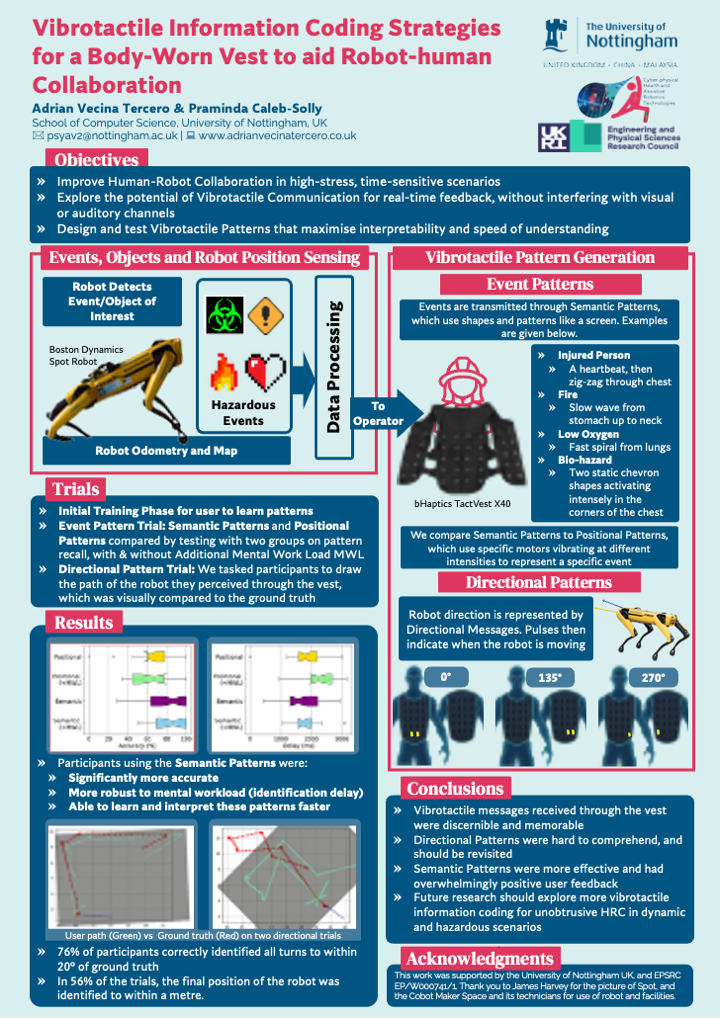
Project poster

This poster summarises the study motivation, vibrotactile pattern design, trial structure, results and conclusions.

Poster for Vibrotactile Information Coding Strategies for a Body-Worn Vest to aid Robot-human Collaboration

Citation

@inproceedings{vecinatercero2025vibrotactile,
  title     = {Vibrotactile Information Coding Strategies for a Body-Worn Vest to Aid Robot-Human Collaboration},
  author    = {Vecina Tercero, Adrian and Caleb-Solly, Praminda},
  booktitle = {Social Robotics and Artificial Intelligence},
  series    = {Lecture Notes in Artificial Intelligence},
  volume    = {15563},
  pages     = {467--478},
  publisher = {Springer Nature Singapore},
  year      = {2025},
  doi       = {10.1007/978-981-96-3525-2_39}
}